As published by the Zambia Daily Mail on May 09th2026
Agnes is 47 years old. Every morning at 04:30, she wakes up in her two-room house in Chawama Township, Lusaka, to start frying mandazi before the school run. She does this not out of choice, but because her husband, Bwalya, has not held a steady job in three years. Most mornings, he is still asleep—or more accurately, still unconscious—from the night before.
By 07:00 hours, the familiar smell of kachasu fills the small house as he stirs. By 09:00 hours, he is gone again, back to the corner where he and his drinking companions gather beneath a mango tree near the market. By evening, Agnes will have cooked, fed the children, paid a neighbour to watch the baby, worked her roadside stall, and returned home to find him either absent or volatile. Agnes’s story is not unique. It is the story of hundreds of thousands of Zambian families.
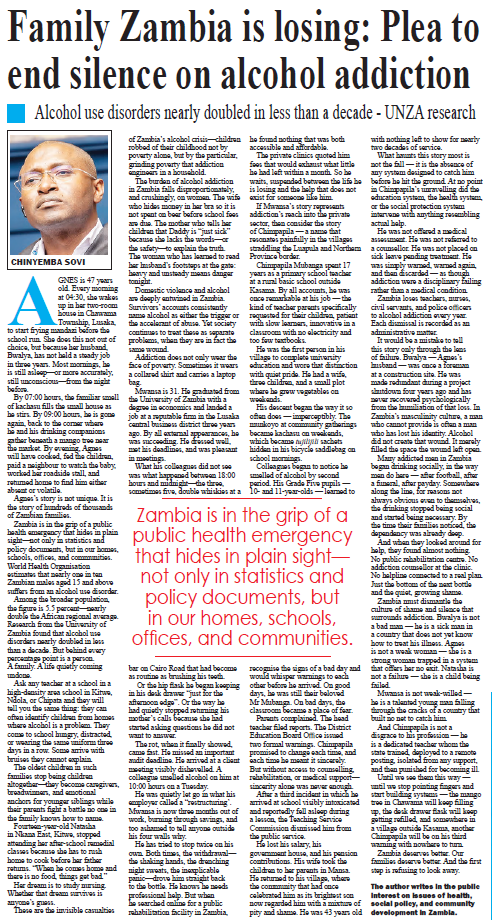
Zambia is in the grip of a public health emergency that hides in plain sight—not only in statistics and policy documents, but in our homes, schools, offices, and communities. World Health Organisation estimates that nearly one in ten Zambian males aged 15 and above suffers from an alcohol use disorder. Among the broader population, the figure is 5.5 percent—nearly double the African regional average. Research from the University of Zambia found that alcohol use disorders nearly doubled in less than a decade. But behind every percentage point is a person. A family. A life quietly coming undone.
Ask any teacher at a school in a high-density area school in Kitwe, Ndola, or Chipata and they will tell you the same thing: they can often identify children from homes where alcohol is a problem. They come to school hungry, distracted, or wearing the same uniform three days in a row. Some arrive with bruises they cannot explain. The oldest children in such families stop being children altogether—they become caregivers, breadwinners, and emotional anchors for younger siblings while their parents fight a battle no one in the family knows how to name.
Fourteen-year-old Natasha in Nkana East, Kitwe, stopped attending her after-school remedial classes because she has to rush home to cook before her father returns. “When he comes home and there is no food, things get bad.” Her dream is to study nursing. Whether that dream survives is anyone’s guess. These are the invisible casualties of Zambia’s alcohol crisis—children robbed of their childhood not by poverty alone, but by the particular, grinding poverty that addiction engineers in a household. The burden of alcohol addiction in Zambia falls disproportionately, and crushingly, on women. The wife who hides money in her bra so it is not spent on beer before school fees are due. The mother who tells her children that Daddy is “just sick” because she lacks the words—or the safety—to explain the truth. The woman who has learned to read her husband’s footsteps at the gate: heavy and unsteady means danger tonight.
Domestic violence and alcohol are deeply entwined in Zambia. Survivors’ accounts consistently name alcohol as either the trigger or the accelerant of abuse. Yet society continues to treat these as separate problems, when they are in fact the same wound.
Addiction does not only wear the face of poverty. Sometimes it wears a collared shirt and carries a laptop bag. Mwansa is 31. He graduated from the University of Zambia with a degree in economics and landed a job at a reputable firm in the Lusaka central business district three years ago. By all external appearances, he was succeeding. He dressed well, met his deadlines, and was pleasant in meetings. What his colleagues did not see was what happened between 18:00 hours and midnight—the three, sometimes five, double whiskies at a bar on Cairo Road that had become as routine as brushing his teeth. Or the hip flask he began keeping in his desk drawer “just for the afternoon edge”. Or the way he had quietly stopped returning his mother’s calls because she had started asking questions he did not want to answer. The rot, when it finally showed, came fast. He missed an important audit deadline. He arrived at a client meeting visibly dishevelled. A colleague smelled alcohol on him at 10:00 hours on a Tuesday. He was quietly let go in what his employer called a “restructuring’. Mwansa is now three months out of work, burning through savings, and too ashamed to tell anyone outside his four walls why. He has tried to stop twice on his own. Both times, the withdrawal—the shaking hands, the drenching night sweats, the inexplicable panic—drove him straight back to the bottle. He knows he needs professional help. But when he searched online for a public rehabilitation facility in Zambia, he found nothing that was both accessible and affordable. The private clinics quoted him fees that would exhaust what little he had left within a month. So he waits, suspended between the life he is losing and the help that does not exist for someone like him.
If Mwansa’s story represents addiction’s reach into the private sector, then consider the story of Chimpapila — a name that resonates painfully in the villages straddling the Luapula and Northern Province border. Chimpapila Mubanga spent 17 years as a primary school teacher at a rural basic school outside Kasama. By all accounts, he was once remarkable at his job — the kind of teacher parents specifically requested for their children, patient with slow learners, innovative in a classroom with no electricity and too few textbooks. He was the first person in his village to complete university education and wore that distinction with quiet pride. He had a wife, three children, and a small plot where he grew vegetables on weekends. His descent began the way it so often does — imperceptibly. The munkoyo at community gatherings became kachasu on weekends, which became tujilijili sachets hidden in his bicycle saddlebag on school mornings. Colleagues began to notice he smelled of alcohol by second period. His Grade Five pupils — 10- and 11-year-olds — learned to recognise the signs of a bad day and would whisper warnings to each other before he arrived. On good days, he was still their beloved Mr Mubanga. On bad days, the classroom became a place of fear. Parents complained. The head teacher filed reports. The District Education Board Office issued two formal warnings. Chimpapila promised to change each time, and each time he meant it sincerely. But without access to counselling, rehabilitation, or medical support— sincerity alone was never enough. After a third incident in which he arrived at school visibly intoxicated and reportedly fell asleep during a lesson, the Teaching Service Commission dismissed him from the public service. He lost his salary, his government house, and his pension contributions. His wife took the children to her parents in Mansa. He returned to his village, where the community that had once celebrated him as its brightest son now regarded him with a mixture of pity and shame. He was 43 years old with nothing left to show for nearly two decades of service.
What haunts this story most is not the fall — it is the absence of any system designed to catch him before he hit the ground. At no point in Chimpapila’s unravelling did the education system, the health system, or the social protection system intervene with anything resembling actual help. He was not offered a medical assessment. He was not referred to a counsellor. He was not placed on sick leave pending treatment. He was simply warned, warned again, and then discarded — as though addiction were a disciplinary failing rather than a medical condition.
Zambia loses teachers, nurses, civil servants, and police officers to alcohol addiction every year. Each dismissal is recorded as an administrative matter. It would be a mistake to tell this story only through the lens of failure. Bwalya — Agnes’s husband — was once a foreman at a construction site. He was made redundant during a project shutdown four years ago and has never recovered psychologically from the humiliation of that loss. In Zambia’s masculinity culture, a man who cannot provide is often a man who has lost his identity. Alcohol did not create that wound. It merely filled the space the wound left open.
Many addicted men in Zambia began drinking socially, in the way men do here — after football, after a funeral, after payday. Somewhere along the line, for reasons not always obvious even to themselves, the drinking stopped being social and started being necessary. By the time their families noticed, the dependency was already deep. And when they looked around for help, they found almost nothing. No public rehabilitation centre. No addiction counsellor at the clinic. No helpline connected to a real plan. Just the bottom of the next bottle and the quiet, growing shame.
Zambia must dismantle the culture of shame and silence that surrounds addiction. Bwalya is not a bad man — he is a sick man in a country that does not yet know how to treat his illness. Agnes is not a weak woman — she is a strong woman trapped in a system that offers her no exit. Natasha is not a failure — she is a child being failed. Mwansa is not weak-willed — he is a talented young man falling through the cracks of a country that built no net to catch him. And Chimpapila is not a disgrace to his profession — he is a dedicated teacher whom the state trained, deployed to a remote posting, isolated from any support, and then punished for becoming ill.
Until we see them this way — until we stop pointing fingers and start building systems — the mango tree in Chawama will keep filling up, the desk drawer flask will keep getting refilled, and somewhere in a village outside Kasama, another Chimpapila will be on his third warning with nowhere to turn. Zambia deserves better. Our families deserve better. And the first step is refusing to look away.